
Capture
Snap. Talk. Type.
Photograph a weigh tag. Say what happened in the cellar. Type one line on the phone. Works offline — buffers locally, syncs when wifi returns.
Once in the cellar.
Once at midnight in February.
Owner · Winemaker · Paperworker · Cleaner. We’d rather be the first two more often.
Snap a weigh tag or say what happened in the cellar. Good Job turns it into lot history, COGS, and TTB-ready records — while the work is still fresh.
For wineries under 10,000 cases.
30 days, no card.
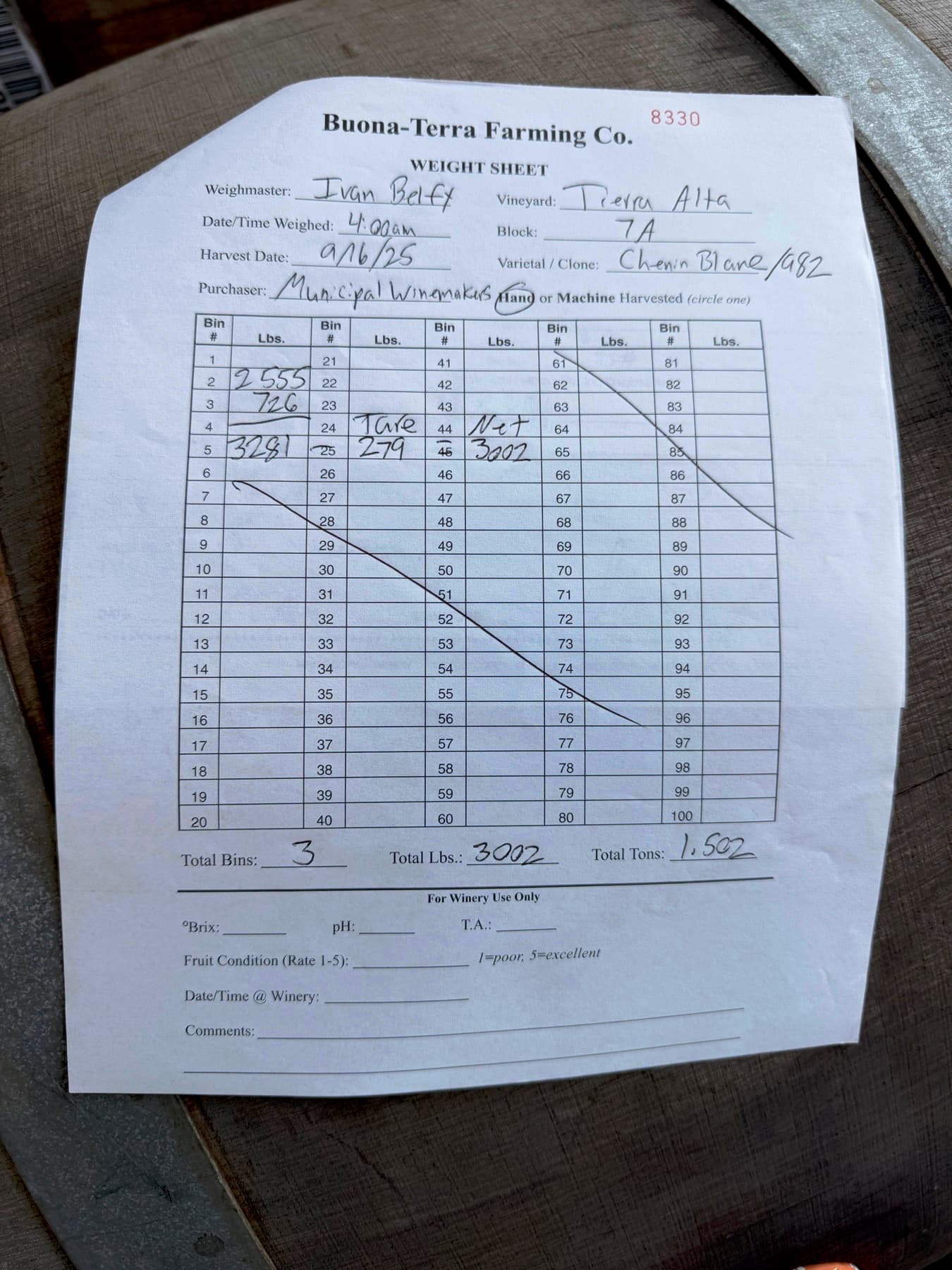
Receival · ready to file
Review fields →Original archived · 184 KB
Buona-Terra Farming Co.
Chenin Blanc 2025 · harvested 2025-09-16
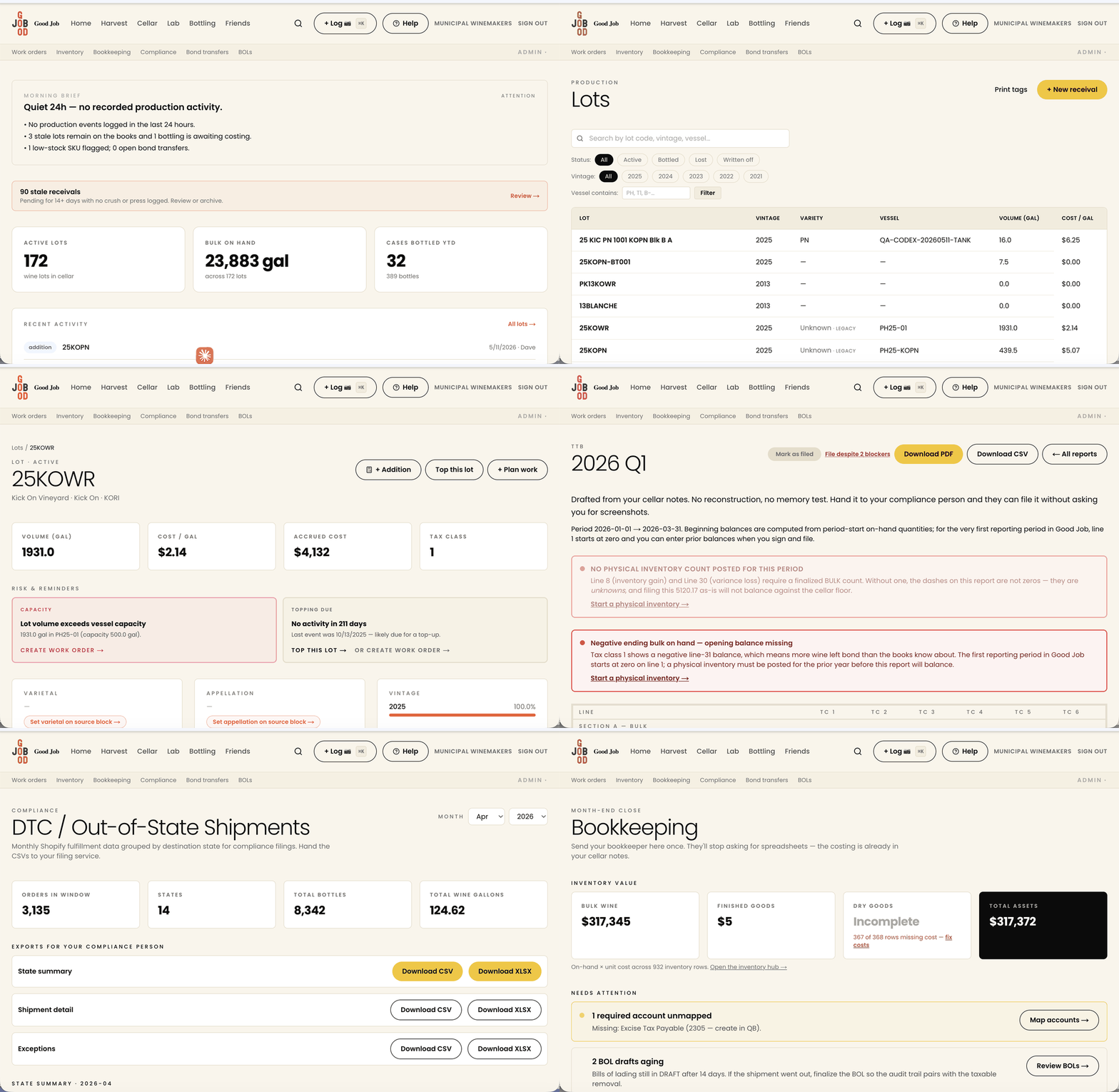
/receivals/scan.Six real screens on the live Municipal Winemakers tenant. Same software you’d sign up to.
Photograph a weigh tag. Say what happened in the cellar. Type one line on the phone. Works offline — buffers locally, syncs when wifi returns.
Live additions math against vessel volume. COGS rolls forward through every rack, blend, and bottling. Lineage from vineyard row to the bottle.
TTB 5120.17 drafts itself. State crush, COLA trace, DTC out-of-state shipments. CSV, JSON, draft JEs to QuickBooks — exports for whoever you hand the month to.
Additions, lab readings, rackings, lot lookups — all of it buffers locally and reconciles the next time you walk into range. No spinner. No “try again later.” No lost note because the router rebooted at 4 a.m.

It’s a story that’s almost cliché now. After a successful career in the wine business — making the wines, running the tasting rooms, working with world-class vineyards — I followed my true passion and started a SaaS company focused on record-keeping and compliance.
Here’s the actual reason. Last year the TTB audited me. Not because I cheated — because I was chronically late filing my 5120s, quarter after quarter, months behind. Every filing season I’d block out two days, dig through cellar notes and receipts, and reconstruct three months of activity from memory. Same problem with my bookkeeper — every month-end, a Sunday pulling together costing for COGS.
I was doing harvest twice. Once in the cellar, once at midnight in February.
Good Job is what I built so that doesn’t happen. Snap a photo of a weigh tag, say what’s happening in plain English, and it files everything in the right place — costing on the lot, gallons on the 5120, draft JEs to the bookkeeper. As it happens, not later from memory. My compliance person logs in and the 5120 is already drafted. My bookkeeper logs in and the costing is already there.
— Dave Potter, Municipal Winemakers
I write “add 30 parts SO₂ to PT351” on the whiteboard. Daniel sees it, does it, types “30 parts to PT351” into Good Job on his phone.
Good Job reads that as: KMBS addition, 30 ppm dose, computed against PT351’s current volume — 4.2 grams — dated, signed by Daniel, added to that wine’s history. No form. No work order. No “did you remember to log it.” Done by the time Daniel walks back across the cellar.
Try it yourself ↓
Founders ($99) for the first 10 wineries. Charter ($149) for the next 15. Standard ($199) after. Lock at signup — forever. Unlimited team members at every tier.
Same product across all three cohorts. The number you see at signup is the number you pay forever.
Built at Municipal Winemakers. Running on live Muni data, every vintage since 2014.
30 days, no card. Trial becomes read-only after that — your data stays.
Your data exports anytime. CSV + JSON, one click. We don’t sell or share it.
Asked by real winemakers on real sales calls. Reproduced as written.
Most people start by trying the Quick sandbox above. If it feels useful, start a free trial with your own winery. If you want help importing a spreadsheet or setting up your first vintage, book a setup call.
Probably yes if you own your winery and you find yourself reconstructing records after the fact — for the TTB, for your bookkeeper, for yourself. Probably not if you have a corporate parent or approval chains. No shame in not being our customer; InnoVint and Vintrace are good at what they do.
Your account becomes read-only. Your data stays. No card on file means no surprise charges, ever — you choose to subscribe or you don’t. If you walk, your full history exports as CSV & JSON in one click.
Almost certainly yes. Send us your .xlsx (or .numbers, .ods, a folder of CSVs) and we’ll show you what we found before you commit to anything. Most onboardings move ten years of vintage data in under an hour.
Cohort pricing rewards early conviction. Founders Cohort is $99/mo for the first ten wineries. Charter Cohort is $149/mo for wineries 11–25. Standard is $199/mo after that. The product is identical at every tier. Whatever you sign up at is locked, forever — same wine, same pour, just different timing on when you walked in. Above 10,000 cases or multi-entity ops, we set custom pricing one-on-one.
QuickBooks & Xero, yes — for cost-of-goods rollups. Vinsight & Innovint, we read your export. Most of our customers come from spreadsheets, but we won’t be the reason you can’t switch.
No, full stop. We don’t sell or share data. Future peer-benchmark features (vintage 2027) are opt-in, aggregate-only, and threshold-gated — no individual winery is reverse-engineerable from the cohort. Hosted on US-region Postgres (Neon), edge on Vercel, source-document storage on Cloudflare R2, auth via Clerk. Every change captured in an immutable event log — TTB-audit-grade by design. CSV + JSON export, one click, any time — including after you cancel.
Every event has a lineage. The 5120.17 generates from your actual log. We’ll sit on the call with your auditor if you want company — we’ve done it twice this year. Pass rate is the only KPI we care about.
Still wondering? Email hello@goodjob.wine — answered by a person, usually within the day.
Honest fit, not a feature checklist. The winery industry has good software at scale — we built Good Job for the part that doesn’t.
A cellar notebook that writes itself. The same notes feed compliance, COGS, audit trail, and team reference. One source, everywhere — no reconstruction at midnight in February.
| Compared by fit | Good Job | InnoVint / vintrace | Spreadsheet |
|---|---|---|---|
| Best for | Owner-operator wineries under 10,000 cases | Larger production teams, multi-role ops | Getting started, until you can’t |
| Setup | Sample cellar, spreadsheet import, half-day guided onboarding | Implementation project, weeks | Already there |
| Daily logging | Phone-first — Quick sentences, Snap a tag | Structured production workflows on the desktop | Manual, on a laptop, after hours |
| Compliance | TTB & CDFA generated from your cellar notes | Strong production compliance, configured | Fragile — reassembled every quarter |
| Cost | $99 / $149 / $199 cohort pricing — every feature, every cohort | Quote-based, higher | “Free,” until it isn’t |
| Philosophy | Built for the person doing the work | Built for organizations with process | Built by necessity |
Drop your file in. We map columns to lots, show our work, and let you fix anything that looks off — before a single row is filed. Eleven years of Muni’s records landed in forty minutes, gallons right to the third decimal.
Reads lot notes & ledgers, receivals and weigh-tag PDFs, lab logs (any column order), bottling runs & case counts, your old 5120 worksheets, cost spreadsheets with formulas.
.xlsx, .numbers, .csv, .ods — even five of them.
Tabs, merged cells, that one weird column from 2017. We've seen it.
Every row classified. Every guess flagged.
See the proposed lots and movements before anything commits. One click rewires a column.
Ten years of history, native in Good Job.
Lineage preserved. Costs roll forward. Your spreadsheet stays in Dropbox as backup.
30 days · no card · cancel by closing the tab.